


Get quote
Get Free Consultation!
We are ready to answer right now! free consultation.
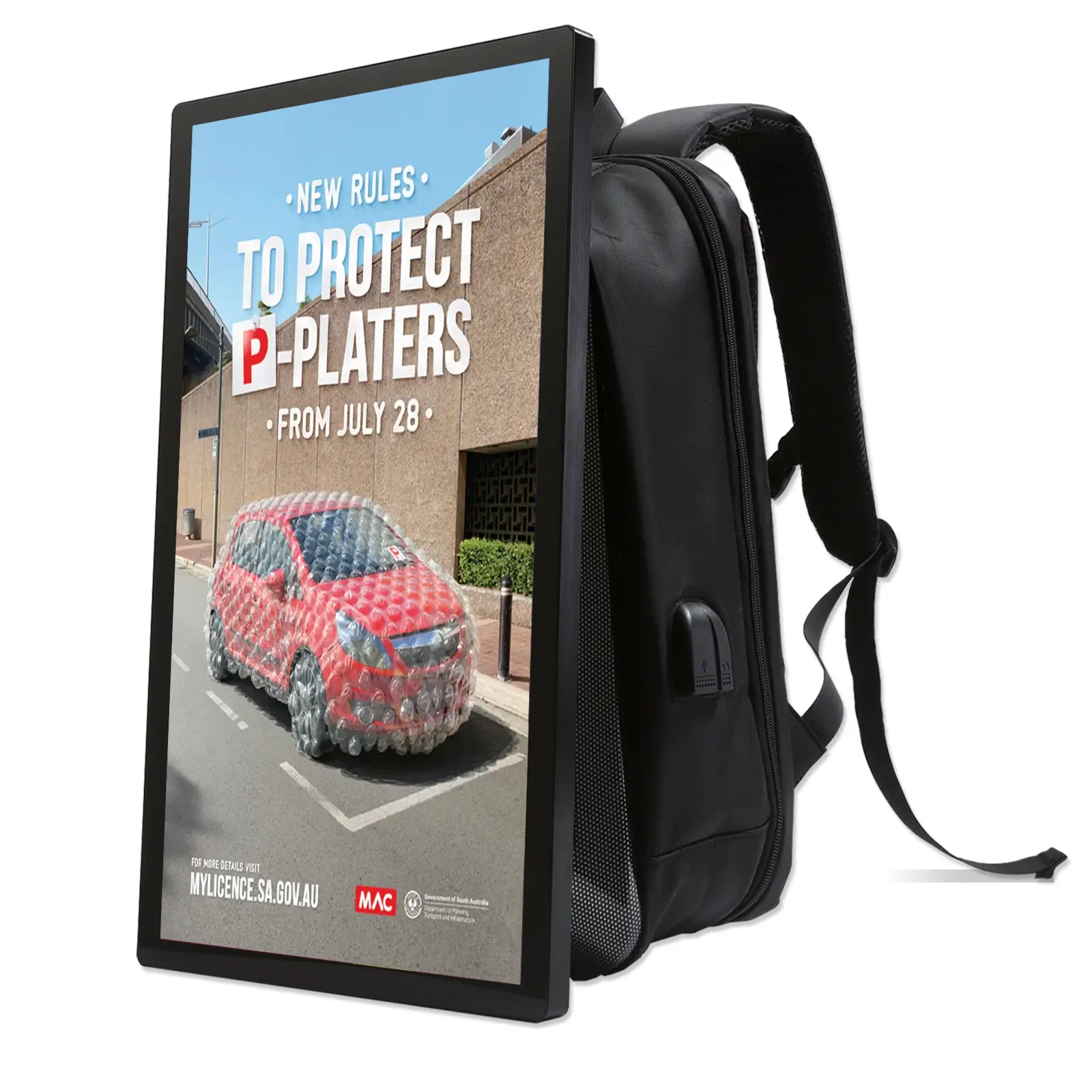
An LCD backpack advertising display supplier should receive a campaign plan that includes the wearer, the route and the charging arrangement. Screen size matters, but a moving campaign also depends on how the complete unit is carried, when it returns to a base and what conditions it encounters between stops. Those decisions need evidence from the selected configuration.
LINGHUFOX lists 21.5-inch, 27-inch and 32-inch backpack displays. The available information provides useful starting specifications, but it does not establish a universal wearing duration, battery runtime or weather rating. This guide explains how to turn those limits into a workable activity brief. The suggested trials are planning steps, not reports of tests already performed.
Start with where the equipment will operate: an exhibition aisle, an indoor retail activation, a reception area or a route between promotional stops. Describe whether the wearer is mainly standing, walking or alternating between the two. A display used beside a staffed stand has a different support arrangement from one moving far from its charging base.
Separate the event’s opening hours from the time each unit must operate between returns. Include preparation, content checks, movement to the first location, active promotion and the return journey. Then identify where staff can remove the equipment, report a problem or exchange an approved complete unit if the plan includes one.
A useful campaign record connects each operating period to a route, a responsible person and a return point. Avoid scheduling to an assumed battery limit before the selected display has been evaluated. The purpose of the initial plan is to expose what must be demonstrated, not to invent an uninterrupted all-day duty claim.
Also explain what the moving display contributes to the campaign. Is it carrying one recognizable message between several areas, supporting a presenter at planned stops or directing visitors to a nearby activity? That choice affects the required screen size, content complexity and how long a customer is likely to see the image.
The 21.5-inch backpack display and 27-inch backpack display both list Full HD 1920 × 1080 content, Android 11.0 and brightness of 500 cd/m². Their battery and weight entries differ. Keep the published values separate from measurements of the complete unit prepared for the event.
| Model | Listed battery | Listed weight | Unresolved for the campaign |
|---|---|---|---|
| 21.5-inch | 12 V, 20,000 mAh | 3.8 kg | Whether that weight includes battery and all carrying parts; actual runtime |
| 27-inch | 12 V, 10,800 mAh | 6 kg | Complete ready-to-wear weight and actual runtime |
| 32-inch | Not established in the reviewed text | Not established in the reviewed text | Full battery, weight and operating specification |
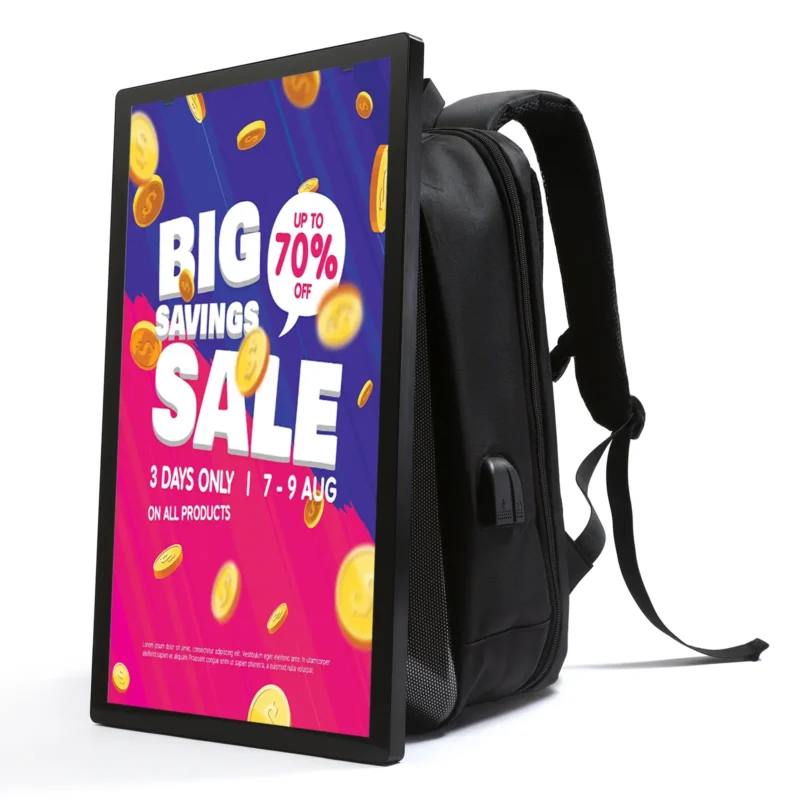
Ask the supplier what is included in the stated weight, then weigh the ready-to-wear sample with the actual battery, harness and attached accessories. Keep the component list with that measurement. A carton weight is a shipping figure, while a bare display weight may omit items the person must carry. Neither should silently become the campaign’s carried-load value.
HSE’s manual-handling assessment guidance considers the task, load, environment and individual capability together. It includes carrying distance and frequency, rather than treating weight as the only factor. For a campaign organizer, this supports assessing the actual work with the people who will perform it instead of declaring one display weight comfortable for everyone.
Review the fit of the supplied straps and carrying system using the manufacturer’s instructions. Include putting on and removing the unit, turning in the available space and reaching the planned rest point. Ask the wearer for feedback during the proposed trial. Do not infer comfortable extended use from a photograph of the product on a person.
The 32-inch backpack model is described for larger promotional visuals and mobile event campaigns, but its reviewed page does not provide the full numerical specification needed for a load comparison. Obtain those details before assigning it a longer route or assuming its battery and brightness match another size.
Compare the campaign message at each shortlisted size while preserving the same viewing task. If the smaller model communicates the intended message adequately, the larger one needs a specific benefit to justify its different equipment arrangement. If the larger image is necessary, adjust the activity plan around the complete unit that will actually be supplied.
The detailed pages also list package sizes: 54 × 36 × 20 cm and 8 kg for the 21.5-inch model, and 74 × 16 × 48 cm and 10 kg for the 27-inch model. These are useful reference figures for transport and staging, not the dimensions or mass to assign to the wearer. Confirm the packing configuration in the actual offer, particularly if accessories are shipped separately.
Identify where the units are unpacked and where their protective packaging remains during the event. The preparation area needs enough room to inspect the display, match chargers to units and organize carrying accessories. At the end of a session, distinguish equipment ready for the next activity from equipment awaiting inspection or charging. A clear return arrangement prevents the event team from discovering that the only available storage space is also the public circulation route.
Have staff report loose straps, damaged enclosures or missing accessories before the next dispatch. Use the supplier’s inspection and service instructions to decide what can return to operation.
The 21.5-inch and 27-inch battery entries are capacity specifications, not measured campaign durations. The published numbers do not show how long the intended playlist will run at the selected brightness with the chosen connections active. They also do not establish charging time or a hot-swap capability. Those details need configuration-specific evidence.
Use the actual campaign file, playback application and intended display settings in the proposed runtime trial. Record the battery identification, starting condition, brightness setting, audio use, wireless connection and observed operating time. Include how the unit indicates low charge and what the operator is expected to do at that point.
A useful result is a recorded duration for one known configuration under stated conditions. A successful short video demonstration does not establish a whole shift. If the settings or battery option change, reconsider the evidence before keeping the original schedule. Build the return-to-base plan around the validated result and the operator’s assessment, with room for normal activity variation.
The product pages list a 12 V / 3–5 A adapter specification. That line alone does not identify the exact charger approved for every battery option. Obtain the battery chemistry, charger model and operating instructions as part of the supplied configuration. Do not select a substitute solely because its connector appears to fit.
Identify the charging location, responsible person, approved chargers and the way charged and returned units are distinguished. Keep charging equipment accessible to the person supervising it. The U.S. Fire Administration’s battery guidance emphasizes following product instructions for use, storage and disposal. The exact battery instructions should govern this campaign’s charging arrangement.
If the supplied battery is lithium-ion, the USFA’s lithium-ion education guidance adds specific advice on suitable chargers, charging conditions and inspection. The reviewed LINGHUFOX battery entries do not establish chemistry, so confirm that first. Do not convert general battery advice into a claim that these units have a particular certification.
Plan the logistics of a depleted or damaged unit without improvising battery changes during a busy event. If an exchangeable battery or spare complete display is part of the offer, have the supplier demonstrate its approved procedure. If it is not, the schedule should allow the unit to return for the documented charging process.
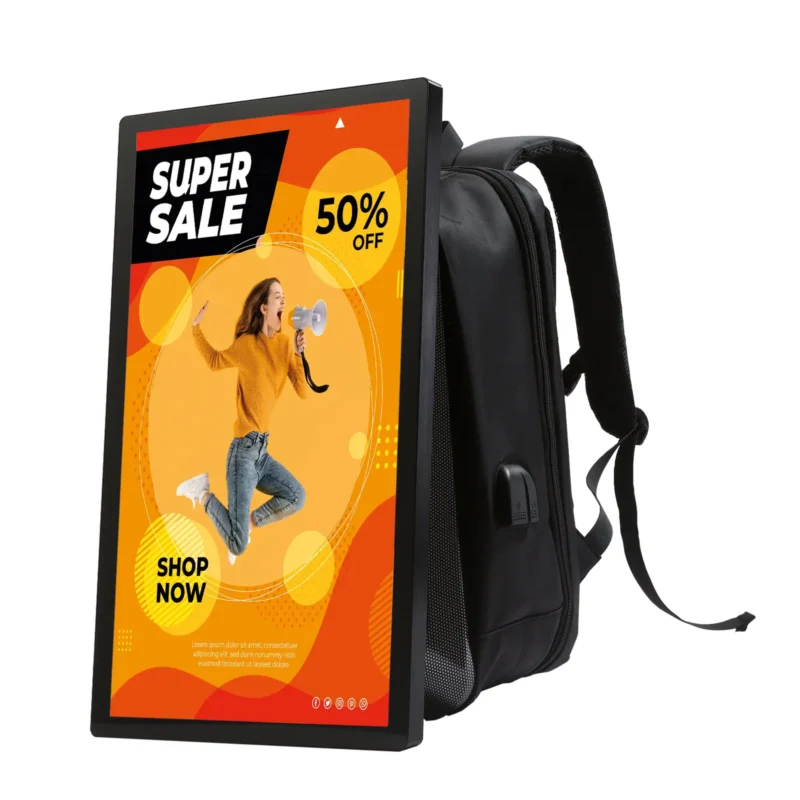
Walk through the proposed route with its operating conditions in mind. Record narrow passages, changes in floor level, busy queues and places where the wearer needs to turn or stop. Include the journey back to the base. These details can change the suitability of a campaign even when the display works correctly on a bench.
HSE’s risk-reduction guidance discusses changing the task, load and working environment, including carrying distances and work routines. Applying that principle may mean shorter operating sections, fewer carried accessories or a different display format at a fixed location. It does not support assigning one universal safe wearing time to every person.
The 21.5-inch and 27-inch products list 500 cd/m² brightness and an operating temperature range of 0–40°C. These facts do not demonstrate visibility in direct sunlight or resistance to rain. The 32-inch page mentions outdoor activations, but the reviewed material does not provide an enclosure protection rating for that use.
IEC 60529 classifies protection provided by electrical enclosures. An outdoor campaign should therefore ask for the protection evidence and operating instructions for the actual assembled configuration, including relevant openings and connections. A generic outdoor-use description cannot fill that evidence gap.
State what the team will do if the route becomes wet or conditions fall outside the approved limits. A move indoors or a paused activity may be appropriate. Do not improvise a cover that changes ventilation or access without the supplier’s approval. Decide the response before the event, when there is time to choose an alternative location.
Show the campaign from the direction a visitor will actually approach. Use the primary brand message and the smallest text customers genuinely need to read. A person seeing a backpack pass by may not encounter the beginning of a long sequence. Make each useful part of the loop understandable when viewed on its own.
Check the same artwork while the wearer is stationary and moving through a representative area. If the message needs a pause, provide a planned stopping position instead of assuming a larger screen solves the timing problem. Confirm any audio use with the venue and the campaign plan; a listed audio capability does not make sound appropriate in every location.
Wi-Fi support does not establish continuous coverage. Both detailed product pages list a 4G module as optional, so confirm that option and any required service before relying on it. Demonstrate the actual playback and update behavior when the intended connection is unavailable. Do not assume offline continuation, remote updates or automatic recovery without seeing the selected application perform them.
Keep a simple dispatch record with the unit identity, approved content version, battery status, carrying configuration and planned return point. Include who can stop the activity or arrange assistance. The record should refer to the tested settings and supplier instructions, rather than a broad promise that the backpack is suitable for all-day use.
A useful brief for an LCD backpack advertising display supplier makes the operating periods and their limits visible. Once the complete load, actual playback duration, charging arrangement and route conditions are established, the campaign can be planned around the equipment that will be worn.
