


Get quote
Get Free Consultation!
We are ready to answer right now! free consultation.
A store opening date is not the same thing as a factory dispatch date. When working with a digital signage manufacturer in China, an overseas buyer needs a plan that connects product approval, production, transport and local installation. Start by fixing the display configuration and the responsibilities at each handoff. A low unit price is difficult to evaluate when the quotation leaves the player, mounting accessories or delivery scope unresolved.
LINGHUFOX offers fixed indoor signage, rotating touch displays and backpack advertising screens, with published support for customization and export coordination. The 32-inch floor-standing display and 55-inch wall-mounted display are sensible starting points for retail installations. Their order files should remain separate: a freestanding cabinet and a wall-mounted screen create different information needs for the buyer, carrier and installer.
Configuration agreed → Sample accepted → Shipment released → Installation ready
Consider an overseas retailer ordering displays while a local contractor finishes the stores. The purchasing team may focus on screen sizes, while the contractor needs dimensions, fixing details and connection locations. If those conversations happen separately, both parties can believe the project is ready even though the installation information has not been agreed. Send one coordinated brief that identifies each display’s job and proposed location.
For the 32-inch floor-standing unit, the brief should show the intended customer approach and the space available for the cabinet. Its listed Full HD 1920 × 1080 display and Android 9.0 platform identify a potential playback configuration. They do not describe the available space around the base or the route to the power outlet. Those details belong in the site information sent to the supplier.
The floor-standing listing supports scheduled playback and Wi-Fi or Ethernet connectivity. Decide whether the retailer’s staff, the distributor or a separate content operator will manage that function. Ask for a demonstration using the proposed route before approving the order. A sample that plays a local video successfully has not yet demonstrated a remotely managed multi-store workflow.
Have the supplier identify the offered operating system and player build in the quotation. If a particular application is required, provide its compatibility requirements and ask for a trial on that configuration. Do not assume that a familiar Android name means every application, remote-management tool or update policy will work identically. The useful outcome is an agreed configuration with an identified operator, not an unexplained promise of remote control.
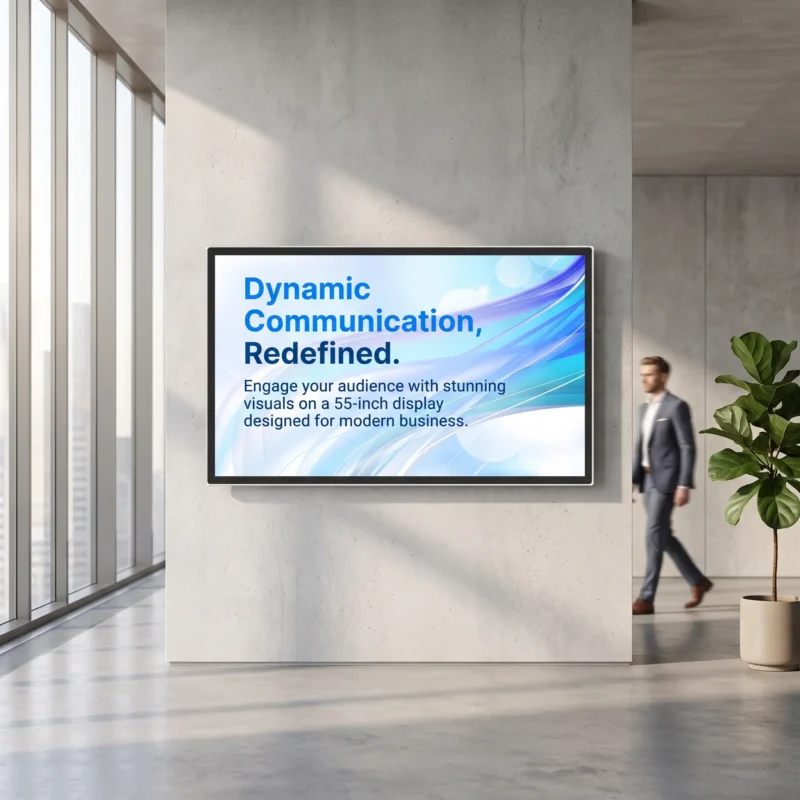
The 55-inch wall model lists HDMI input as optional. A local contractor planning an external media player needs that option confirmed before cabling is finalized. Identify the intended input, cable access and bracket arrangement together. A connector shown in a general product family illustration should not be treated as an included component unless the quoted configuration confirms it.
The same rule applies to mechanical information. Ask for the mounting details for the exact screen and selected bracket, then have the local installer assess the supporting structure. Do not authorize drilling from a screen diagonal or a photograph. The installer needs the actual fixing arrangement and product weight relevant to the offered build, while the supplier needs to know about any recessed or restricted installation position.
A sample has value when the buyer knows which questions it is meant to answer. For the floor-standing model, a trial can demonstrate the intended content process and the cabinet’s practical access arrangement. For the wall-mounted model, it can help verify the selected input and display configuration. Neither sample automatically proves the suitability of a different enclosure, player board or operating-system option introduced later.
Prepare a short acceptance record around the actual project. For a café menu, show the menu content, the intended orientation, the update process and the expected power-on behaviour. For a retail entrance display, include the promotional artwork and an agreed viewing assessment. Describe any outstanding issue in the sample record rather than treating shipment of the sample as approval of the production order.
LINGHUFOX describes customization of logos, casings, software and interfaces in its OEM/ODM and supply services. If a change follows the sample trial, identify what has changed and which earlier approval remains valid. A logo-only adjustment and a revised input arrangement should not pass through the same technical review simply because both are called customization.
For example, a buyer may approve the appearance of the 55-inch wall display, then decide that the local installer will supply the player. That decision reopens the input and software responsibilities even if the screen’s appearance stays unchanged. Record the new signal path and confirm the required option before production release. This is a project change, not a small detail to be settled by the receiving team.
The production release should identify the model, selected options, approved appearance and relevant accessories in a form both sides can recognize. Avoid an order line that says only “advertising machine” when the project contains several formats. If the 32-inch floor unit and the 55-inch wall unit use different players or mounting arrangements, preserve those distinctions in the order description and associated drawings.
For a buyer adding the 21.5-inch rotatable touch smart display, the order can reference its listed Android 12 platform, 4 GB RAM, 64 GB storage and ten-point capacitive touch. The selected application and approved orientation behaviour still need their own record. Those practical requirements do not follow automatically from the memory capacity or the number of touch points.
The rotating display’s Type-C description excludes charging. Pass that information to anyone planning the demonstration area or power accessories. Otherwise, the purchasing team may approve the correct hardware while another team prepares an unsuitable power arrangement. A coordinated order file should expose such limitations early, without expecting every participant to rediscover them in a long specification table.
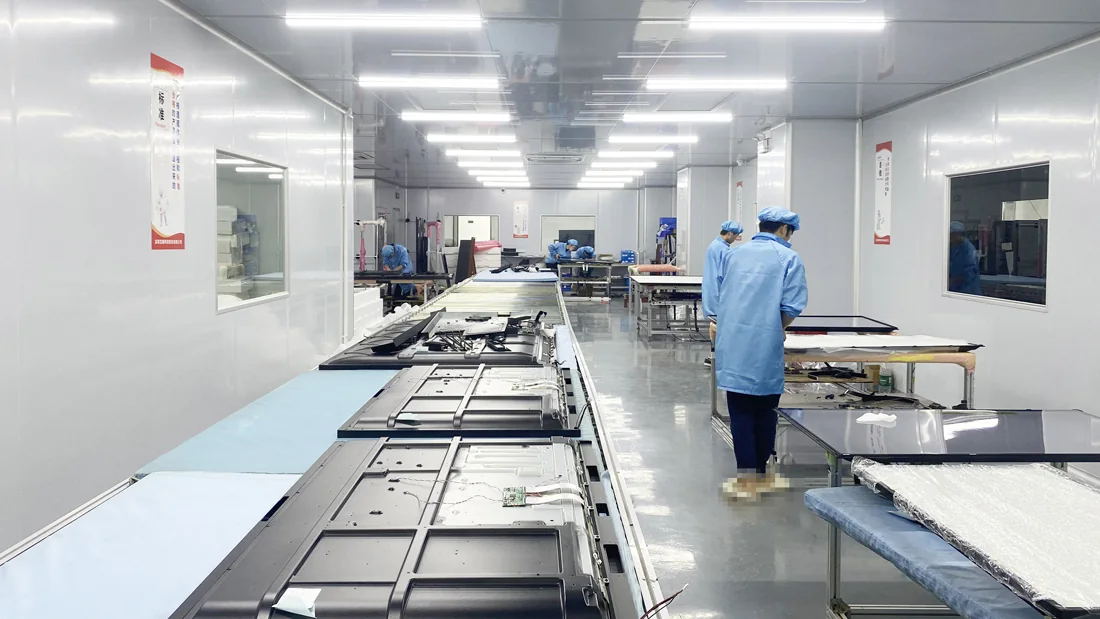
LINGHUFOX’s published workflow includes component checks, functional testing, aging and packing, with production and packing photographs available for communication. Ask which records can identify your selected build. A photograph of a powered display is useful evidence of that moment, but it does not answer every question about application compatibility, software support or the suitability of the final installation.
The carrier and receiving team need information about the packed product, not only its operating dimensions. The 55-inch wall-display listing gives a carton size of 1360 × 855 × 180 mm and an approximate gross weight of 31.5 kg. Use those published figures as an early planning reference, then obtain the final packing list for the selected configuration and accessories before booking transport.
If the order also contains floor-standing cabinets, separate their packages clearly from the wall screens and brackets. Ask whether bases and accessories are packed with their associated cabinets or separately, and how the receiving team can identify the corresponding pieces. A retailer sending equipment onward to several locations needs that relationship preserved after the main shipment is unpacked.
Now consider an event-equipment buyer adding the 21.5-inch LCD backpack display to an otherwise fixed-signage order. Its listing includes a 12 V, 20,000 mAh battery. Do not assume that the packing and transport arrangement used for a mains-powered wall screen automatically covers the battery-equipped kit. Give the chosen logistics provider the actual battery and packing information and obtain its acceptance requirements before dispatch.
Ask the supplier which battery documentation is available for the offered configuration, and have the logistics provider determine what is required for the route and transport mode. For air freight, IATA’s lithium-battery shipping guidance explains why airline and destination requirements need checking before a shipment is offered for carriage. First confirm the actual battery chemistry and kit configuration. This guide does not assign a transport classification or promise carrier acceptance.

Destination documentation also needs model-specific review. Establish which product identifiers and configuration details will appear in the commercial and technical documents. If compliance evidence is required, request documents whose scope matches the actual products and intended market. A company-level certificate image is not proof that every customized display configuration meets every destination requirement.
For the 32-inch floor-standing display, agree how the supplier will identify the selected configuration on the order and supporting documents. The product name, Full HD resolution and Android 9.0 platform are useful descriptive details, but the supplier may also use a particular build reference. Obtain that reference rather than inventing a model code. The local installer should be able to connect the arriving cabinet to the configuration approved by the purchasing team without interpreting an unrelated abbreviated description.
The 55-inch wall display needs the same continuity with its selected input option. If the quotation includes HDMI input for an external player, preserve that decision in the approved configuration attachment. A receiving photograph showing the rear connections can then be compared with the agreed arrangement. This is more useful than a general photograph of cartons because it answers a specific installation question before the screen is fixed above a counter.
Make the release record usable by the next team. For the 32-inch floor display, a startup demonstration can identify the agreed Android 9.0 configuration and assigned campaign. For the 55-inch wall display, a rear-connection photograph can identify the external-player input ordered. Agree which evidence is required and who accepts it. These are proposed records, not services assumed to be included in every order.
Distribute the accepted records by responsibility: publishing instructions go to the content operator; bracket drawings and input details go to the installer; package identities go to receiving. Keep a common configuration reference on each file. That lets a team confirm that its instructions describe the arriving equipment without sorting through material intended for every other participant.
If the proposed wall-display player changes before dispatch, revisit the accepted video path with the installer. If the backpack battery configuration changes, pass the revised battery information to the logistics provider rather than retaining the earlier transport file. Neither alteration should disappear into an updated catalogue attachment. Identify the affected display and obtain the relevant party’s response before that version enters the shipment.
A quotation should make its delivery scope intelligible: the agreed term, named place, transport arrangement and responsibilities that matter to the transaction. The International Chamber of Commerce’s explanation of Incoterms® 2020 describes the rules as allocating costs, risks and obligations between buyer and seller. Choose and document the appropriate arrangement with the parties handling the transaction; do not use an undefined “shipping included” phrase as a substitute.
Keep that commercial allocation distinct from product acceptance. The ICC’s introduction to the rules distinguishes their scope from other parts of a sale. The fact that a shipment has reached an agreed location does not tell the installer which input was ordered for the wall screen or which application was approved for the rotating display. Those facts should travel in the technical file. Conversely, an accepted playback demonstration does not settle unloading, onward delivery or local installation responsibilities.
Build the project schedule around confirmed milestones. Ask when the selected configuration can be ready for inspection, when the agreed documents can be supplied, and when the packed goods can be handed to the chosen transport provider. Then allow the local team to plan installation against the actual delivery arrangement. Do not present a production estimate as a guaranteed date when the screens will be operating in the stores.
Before releasing an order to a digital signage manufacturer in China, the retailer should confirm that the installer knows what is arriving, the content operator should know what must be configured, and the receiving team should know how to identify each package. Keep the unresolved items attached to the specific model that still needs a decision. That is how a remote purchase becomes an installable display project rather than a collection of screens waiting for answers at the destination.
