


Get quote
Get Free Consultation!
We are ready to answer right now! free consultation.
A retail rollout can need three different things from one digital signage manufacturer: a freestanding promotion screen, a menu display above a counter, and a narrow information strip beside merchandise. The sensible starting point is not a factory photograph or the largest available screen. It is whether the supplier can connect each display format to your content, installation and acceptance requirements. LINGHUFOX offers these formats alongside OEM/ODM support; establish the configuration of each unit before treating them as one interchangeable order.
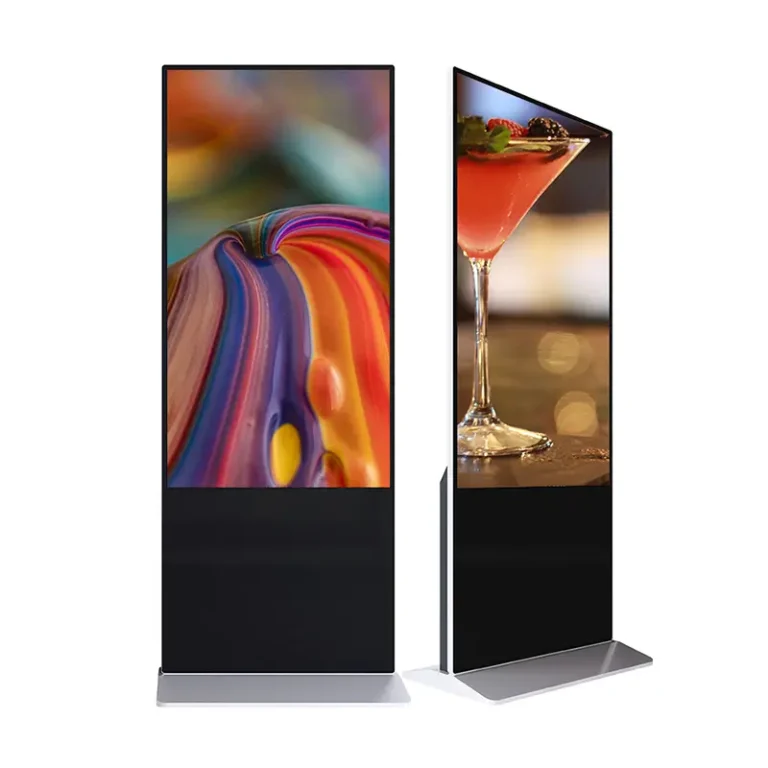
For an initial comparison, the 55-inch floor-standing display and 55-inch wall-mounted display provide a useful contrast. Both can carry commercial messages. They do not occupy the same space, use the same installation method, or necessarily have the same playback hardware. A purchase specification should preserve those differences rather than reduce both products to “55-inch advertising screen.”
Consider a contractor fitting a fashion store with a promotional display near its entrance and an information screen behind the service counter. A floor-standing cabinet puts the message where visitors approach, while a wall-mounted unit leaves the counter and circulation area clear. These are separate installation decisions even when the retailer wants the same campaign on both screens. The contractor needs a cabinet drawing for one location and a supported mounting arrangement for the other.
The LINGHUFOX 55-inch floor-standing model is described as a 4K advertising display with a slim frame, a freestanding base and built-in cooling. Those details make it a relevant candidate for indoor promotional placements. They are not a substitute for the overall cabinet dimensions, base footprint or the proposed power route. Mark the intended position on the store plan, including the space used by customers stopping to look, before approving the cabinet.
With this freestanding format, a clean front elevation is only part of the decision. Request the rear access arrangement and identify which side a technician will use to reach connections. A display that looks tidy against a wall may still need room behind it. Ask how the power lead leaves the base, whether the chosen position needs an approved securing method, and how stock replenishment or cleaning equipment will pass nearby.
The product’s cooling feature should also appear in the installation discussion. Do not surround a ventilation opening with decorative panels simply because the cabinet can physically fit inside them. Have the supplier confirm the clearances for the offered build. For this particular store, the useful evidence is a drawing showing the cabinet in its proposed surroundings, not a general assurance that commercial displays are suitable for retail.
The LINGHUFOX 55-inch wall-mounted display illustrates why a quotation needs more than a resolution label. Its published information lists Full HD and 3840 × 2160 panel configurations, while the technical table separately lists decoding up to 1080p. These statements concern different parts of the system. A panel capable of displaying a particular pixel grid does not, by itself, establish what the included player will decode.
For a store using moving product footage, identify the exact player board, its supported media specification and the selected panel version. Then supply a representative campaign file for demonstration. Look for correct framing, legible fine text and stable playback through the intended publishing method. Do not approve a 4K production workflow solely because 4K appears beside the screen size.
The same product table identifies HDMI input as optional. That distinction matters when an integrator plans to use an external media player. Obtain confirmation that the input is included in the quoted build, then test the intended signal path. An HDMI output socket is not a replacement for an input socket, and an attractive demonstration using the built-in player does not prove the external-player route.
Brightness belongs in a separate decision. The listed 300-nit panel is presented for indoor information and promotional content. Check a sample against the lighting and reflections at the proposed counter. Do not turn this indoor listing into a promise of direct-sunlight readability. The PPDS professional signage catalogue, for example, identifies brightness and operating schedules as separate specifications; the purchasing lesson is to request both for the specific unit offered, not to borrow another manufacturer’s ratings.

Include the store’s opening routine in that wall-display demonstration. The listing supports scheduled playback and power-on/off functions, so have the offered unit follow the proposed daily sequence: power on, load the intended menu, show the correct orientation and remain on the approved content. Ask what happens if connectivity is unavailable during the update window. Establish the expected result before testing; do not assume that every publishing method has the same offline behaviour.
This matters when the display sits beyond easy staff reach. A menu that requires an employee to climb up and dismiss an unexpected screen is not equivalent to a unit that returns to its assigned presentation. Record which settings the supplier configures and which belong to the retailer’s content operator. Where central management is included, confirm who retains access to that account after installation and what service or licence terms apply. BrightSign’s management guides provide an industry example of treating player management as a distinct responsibility; this does not imply that BrightSign hardware or services are included in the LINGHUFOX offer. The panel purchase and the ongoing publishing arrangement should be recognizable as separate parts of the offer.
One supplier can simplify coordination without making every display suitable for every task. The 18.5-inch stretched LCD display addresses narrow retail and information spaces. The 21.5-inch rotatable touch smart display instead supports movable, direct interaction. Their value comes from fitting different customer behaviours, not from being smaller substitutes for a wall-mounted menu.
At a shelf edge or checkout position, a bar-format message may communicate one offer or a queue instruction without taking over the surrounding fixture. Begin with the available opening and the message that must remain readable. Obtain the actual active area and native pixel dimensions for the offered stretched display before artwork is commissioned. The diagonal measurement alone does not tell the designer how much vertical space is available.
The LINGHUFOX listing describes centralized management and remote scheduling for multiple locations. A distributor considering a small network of these screens should therefore demonstrate the actual update process: assign one message to one location, change it, and confirm that other locations keep their own content. This is a proposed acceptance exercise, not a claim about a particular management platform or included licence.
The rotatable model lists Android 12, 4 GB RAM, 64 GB storage and ten-point capacitive touch. These are useful starting details for a guided product presentation or a movable hospitality display. They do not establish compatibility with the buyer’s application. Test the actual interface, including text entry, portrait-to-landscape behaviour and the controls used by a first-time visitor.
For a distributor, this can be a separate demonstration product rather than the standard screen stocked for every branch. A movable, interactive display may suit a staff-assisted conversation; an unattended overhead menu has no reason to require touch. Keeping these uses separate prevents a broad catalogue from becoming a confusing purchase specification.
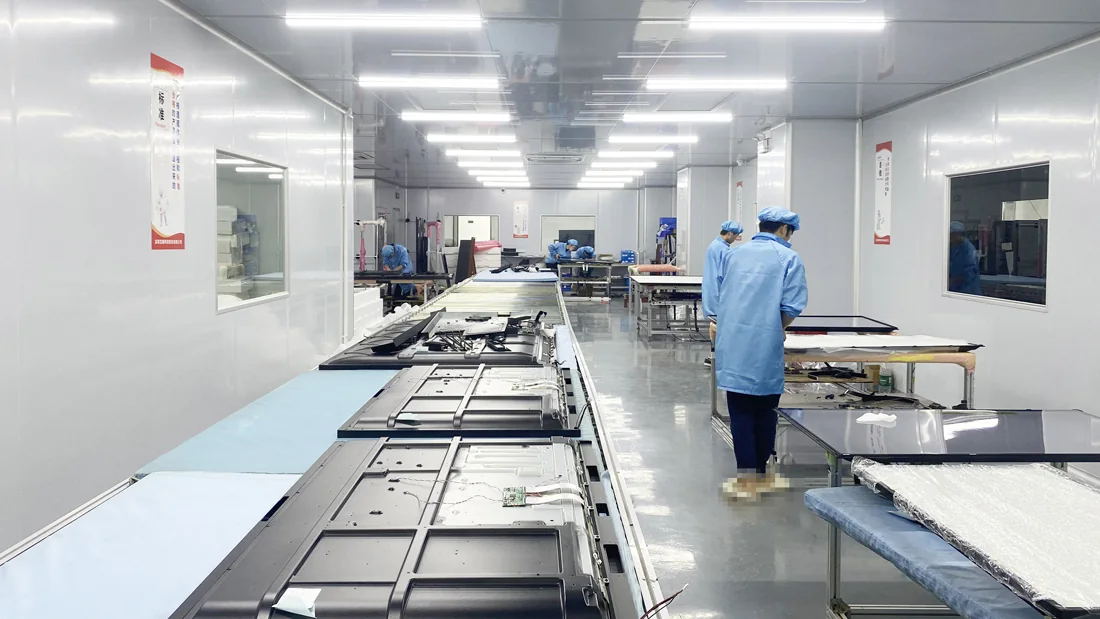
LINGHUFOX’s published manufacturing and project workflow includes component testing, assembly, functional testing, whole-machine aging, and packing for export. It also describes sharing production and packing photographs. Buyers can use that workflow to request evidence tied to their own order. A photograph is most useful when the unit, configuration and stage of inspection are identifiable.
For the 55-inch floor-standing display, a functional record should distinguish the screen and playback checks from cabinet checks. A correct image does not demonstrate that the base supplied matches the approved drawing. For the wall-mounted version, the record should identify the selected resolution and any optional input ordered. For the rotating touchscreen, it should show the agreed application responding to touch rather than merely displaying a static home screen.
| Offered configuration | Evidence to request | Decision it supports |
|---|---|---|
| 55-inch freestanding display | Cabinet and base drawing plus a photographed completed unit | Whether the installed footprint matches the store plan |
| 55-inch wall-mounted display | Selected panel, player and input list with a representative playback demonstration | Whether the complete signal path matches the content plan |
| 21.5-inch rotating touchscreen | Application trial and approved orientation behaviour on the offered configuration | Whether visitors can complete the intended interaction |
Ask separately which compliance documents cover the quoted model and destination. A document displayed among company resources is not enough to establish that every screen, power supply or customized enclosure falls within its scope. Match the model identification and offered build to the documents supplied. Where a custom change is proposed, have its effect on documentation reviewed before production approval rather than after packing.
Imagine a distributor supplying differently shaped stores over several months. The first outlet has space for a 55-inch totem; another needs a wall installation; a third wants a narrow promotional strip. The distributor benefits from one technical contact, but should maintain distinct approved configurations. Reordering by photograph or by “same as last time” leaves too much room for misunderstandings about the player, bracket, operating system or accessories.
For the wall-mounted 55-inch model, the published carton dimensions are 1360 × 855 × 180 mm, with approximately 27 kg net and 31.5 kg gross weight. Treat these as a planning reference for that listed configuration, not a universal packing rule for the entire catalogue. Before arranging delivery to multiple stores, obtain the final packed dimensions and accessory list for the actual shipment.
A freestanding cabinet introduces a different receiving question: whether its base and cabinet arrive assembled or separately, and which installation items belong with each unit. The product overview does not settle that question. Have the supplier’s packing photographs identify the parts associated with each totem, then give the receiving team the same reference. This reduces the chance that a base or power accessory is mistakenly distributed to another outlet.
For the stretched display, label the approved content layout and configuration together. A replacement screen should not arrive with an unrecognized canvas arrangement just before a promotion. For the rotating touchscreen, record the approved application version and account ownership, without placing private login credentials on an exposed packing label. Different products need different continuity records because their failure points during rollout are different.
Before releasing a multi-site order, bring the display schedule, approved drawings, playback demonstration and packing arrangement into one project decision. Each unit should have a clear destination and a clear job. The floor-standing display is approved as a cabinet in a particular retail position; the wall-mounted display is approved as a specified panel-and-player combination; the stretched screen is approved with a suitable message layout; the rotating touchscreen is approved with the application people will actually use.
That is a stronger basis for choosing a manufacturer than collecting the longest list of catalogue features. Keep any unresolved item visible: an optional input not yet confirmed, a bracket arrangement awaiting review, or an application still needing a sample trial. Release the models that meet their requirements, and hold the uncertain configuration until its evidence is complete. A smaller, well-defined first order is more useful than a larger shipment whose details must be discovered on the shop floor.
Source note: Product details refer to the linked LINGHUFOX listings reviewed on October 19, 2026. The store scenarios are illustrative purchasing exercises, not customer case studies or results from physical product testing.
